Introduction: Your Hosting Is Either Growing Your Business — Or Killing It
Your website just went down during your biggest sale of the year. Your ad campaign is live. Money is being spent. Customers are clicking. And they’re landing on a blank page.
Or maybe it’s not that dramatic. Maybe your site is just… slow. Three seconds to load. Four seconds. Five. Every extra second costs you 7% in conversions according to research from major analytics firms [EXTERNAL SOURCE 1]. That’s not a minor inconvenience. That’s revenue evaporating in real time.
Here’s the pattern I see constantly as a web developer who has built and hosted 500+ websites: a business starts on shared hosting because it’s cheap. Things work fine at first. Then traffic grows. The site slows down. Pages take longer to load. Uptime becomes inconsistent. Security scares start happening. And suddenly, the “affordable” hosting plan is costing the business thousands in lost sales, damaged reputation, and SEO penalties.
The fix isn’t a better shared hosting plan. The fix is a fundamentally different architecture.
That’s what cloud hosting is. And in this guide, I’m going to explain exactly what it is, why it outperforms every other hosting type for growing businesses, how it directly impacts your SEO rankings, and how you can switch without breaking the bank.
If your website is important to your business — and it should be — this is probably the most important hosting decision you’ll make this year.
What Is Cloud Hosting? (And How Does It Actually Work?)
Let’s strip away the marketing jargon and explain this simply.
Traditional hosting puts your website on a single physical server. If that server slows down, your site slows down. If it crashes, your site goes offline. If it runs out of resources, your site breaks. You’re tied to one machine, and whatever happens to that machine happens to you.
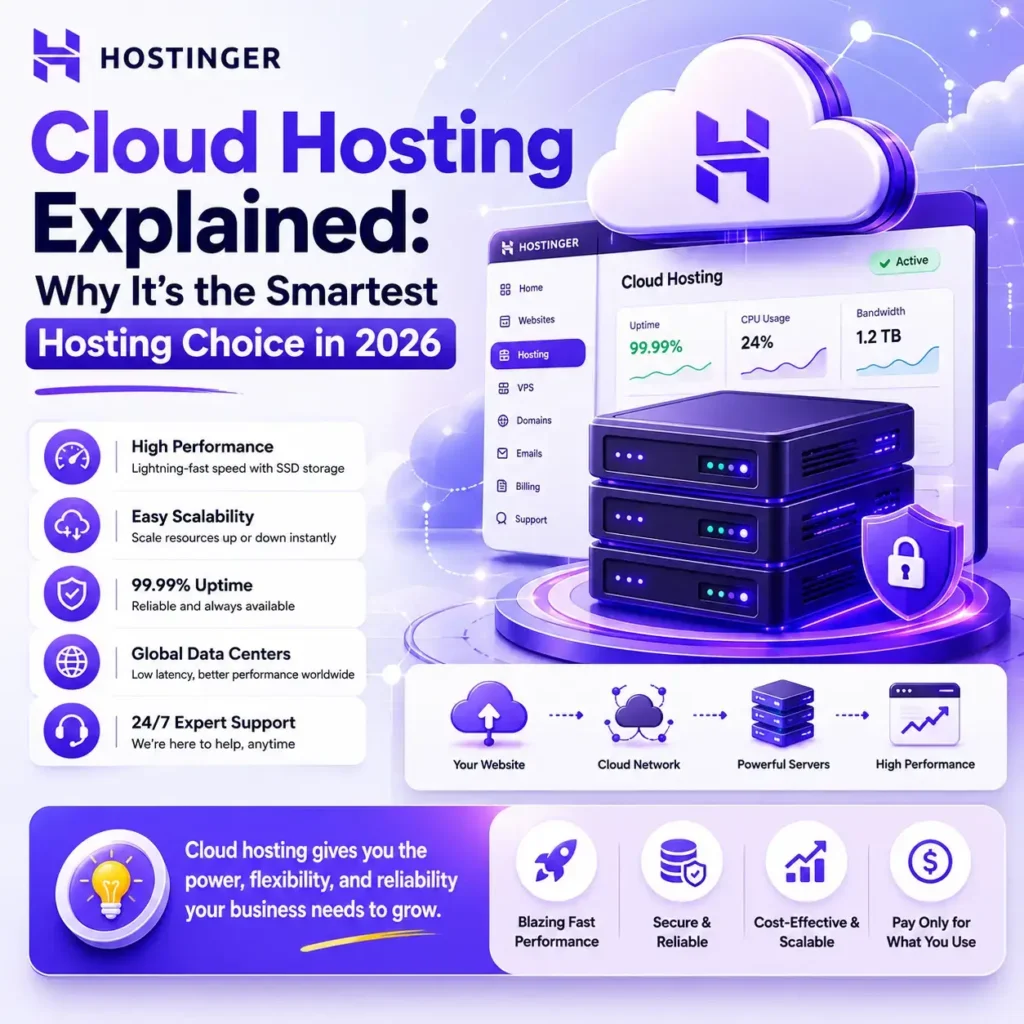
Cloud hosting distributes your website across multiple servers working together as one system. Instead of depending on a single machine, your site runs on a network of interconnected servers — often spanning multiple data centers in different locations.
Think of it this way:
- Shared hosting is like renting a room in a crowded house. Everyone shares the kitchen, bathroom, and electricity. If someone uses too much, you suffer.
- VPS hosting is like renting an apartment. You have your own space, but you’re still in one building. If the building has problems, you have problems.
- Cloud hosting is like having multiple apartments across multiple buildings. If one building has an issue, your stuff is already backed up in another building. You never go offline.
That’s the core advantage: redundancy, scalability, and independence from any single point of failure.
Why Cloud Hosting Is Becoming the Standard
The shift toward cloud hosting isn’t a trend — it’s an infrastructure evolution. The global cloud hosting market has been growing at over 15% annually, and for good reason:
- Websites are getting more complex (heavier pages, more scripts, dynamic content)
- User expectations for speed are higher than ever (Google’s Core Web Vitals)
- Traffic patterns are unpredictable (viral content, seasonal spikes, ad campaigns)
- Security threats are increasing (DDoS attacks, malware, data breaches)
- Google now uses page speed and uptime as direct ranking factors
Traditional hosting simply wasn’t designed for this reality. Cloud hosting was built for it from the ground up.
Top 10 Benefits of Cloud Hosting for Your Business
1. Dramatically Faster Website Speed
Cloud hosting uses load balancing and content delivery across multiple servers to ensure your website loads as fast as possible. Combined with SSD/NVMe storage and optimized server configurations, cloud-hosted websites consistently outperform shared hosting in speed tests.
Why it matters: A 1-second improvement in load time can increase conversions by up to 27% [EXTERNAL SOURCE 2]. Speed isn’t a luxury — it’s revenue.
2. Near-Perfect Uptime (99.99%+)
Because your site runs across multiple servers, if one server fails, another takes over instantly. This automatic failover means your website stays online even during hardware failures, maintenance windows, or unexpected issues.
Most reputable cloud hosting providers guarantee 99.99% uptime — that’s less than 53 minutes of downtime per year. Compare that to shared hosting where a single server crash can take your site offline for hours.
3. Enterprise-Level Security
Cloud hosting environments offer significantly stronger security than shared hosting:
- Isolated server environments — your site isn’t affected by other users’ vulnerabilities
- Built-in DDoS protection — automatic traffic filtering against attacks
- Firewalls and intrusion detection — network-level threat monitoring
- Encrypted data transfer — SSL/TLS across all connections
- Automated backups — regular snapshots for disaster recovery
When your website handles customer data, payment information, or sensitive business content, security isn’t optional. It’s mandatory.
4. Auto-Scaling That Handles Traffic Spikes
Running a flash sale? Went viral on social media? Got featured by a major publication? With shared hosting, your site crashes under the load. With cloud hosting, additional resources are allocated automatically to handle the spike.
You don’t need to predict your traffic. The cloud adapts to it in real time. When the spike passes, resources scale back down — so you’re not paying for capacity you don’t need.
5. Flexible Resource Allocation
Unlike fixed hosting plans where you pay for resources whether you use them or not, cloud hosting lets you pay for what you actually use. Need more CPU during business hours and less overnight? Cloud hosting adjusts dynamically.
This flexibility makes cloud hosting one of the most cost-efficient options for businesses with variable traffic patterns.
6. Better User Experience
Faster pages, zero downtime, and responsive performance create a measurably better experience for your visitors. Better experience means longer session durations, lower bounce rates, more pages viewed, and higher conversion rates.
In eCommerce, the connection between hosting performance and revenue is direct and measurable. Every millisecond counts.
7. Direct SEO Advantages
Google has been clear: site speed, uptime, and security (HTTPS) are ranking factors. Cloud hosting improves all three simultaneously. I’ll break this down in detail in a dedicated section below.
8. Cost Efficiency at Scale
While cloud hosting may cost more than the cheapest shared hosting plans upfront, it delivers significantly better ROI when you factor in performance, uptime, security, and scalability. For any website that generates revenue — whether through sales, leads, or advertising — the cost of cloud hosting pays for itself many times over.
9. Built-In Disaster Recovery
Cloud hosting platforms maintain redundant copies of your data across multiple servers and often multiple geographic locations. If a server fails, a data center loses power, or a natural disaster strikes, your data is safe and your website can be restored rapidly.
This level of disaster recovery used to require enterprise-level budgets. Cloud hosting makes it standard.
10. Business Continuity
All of the above — speed, uptime, security, scalability, backups — combine to create something invaluable: business continuity. Your website stays online, stays fast, and stays secure no matter what. That’s not just a hosting feature. That’s a business insurance policy.
Cloud Hosting vs Shared Hosting: The Full Comparison
| Feature | Shared Hosting | Cloud Hosting |
|---|---|---|
| Server Architecture | Single physical server | Multiple interconnected servers |
| Performance | Affected by other users | Dedicated, consistent performance |
| Speed | Moderate, variable | Fast, optimized |
| Uptime | 99.0% – 99.9% typical | 99.99%+ guaranteed |
| Scalability | Limited, manual upgrades | Auto-scaling, instant |
| Security | Basic, shared vulnerabilities | Isolated, enterprise-level |
| Traffic Spikes | Site crashes or slows | Handles automatically |
| Backups | Often limited or manual | Automated, redundant |
| Root/Server Access | No | Often available |
| Cost | $2 – $15/month | $5 – $50+/month |
| Best For | Personal blogs, hobby sites | Businesses, eCommerce, growing sites |
Bottom line: Shared hosting is fine for a personal blog that gets 100 visitors a month. The moment your website matters to your income, cloud hosting is the only responsible choice.
Cloud Hosting vs VPS Hosting: What’s the Difference?
| Feature | VPS Hosting | Cloud Hosting |
|---|---|---|
| Infrastructure | Single physical server (virtualized) | Multi-server network |
| Redundancy | Single point of failure | Built-in failover |
| Scalability | Manual (upgrade plan) | Automatic (real-time) |
| Uptime | 99.9% typical | 99.99%+ typical |
| Traffic Handling | Fixed resources | Dynamic resource allocation |
| Disaster Recovery | Limited without manual setup | Built-in across data centers |
| Management | Requires technical skills | Often managed options available |
| Cost | Fixed monthly rate | Usage-based or fixed plans |
| Best For | Developers, fixed workloads | Businesses needing reliability + scale |
VPS hosting is a solid step up from shared hosting, and it works well for developers who want full control. But for businesses that prioritize uptime, automatic scaling, and zero single points of failure — cloud hosting is the stronger choice.
For a deeper comparison of hosting types, check out [INTERNAL LINK 1: Hosting Comparison Guide].
🔥 Recommended Cloud Hosting Solution
If you’re ready to move to cloud hosting, here’s the provider I recommend based on my experience building and managing hundreds of websites:
Hosting Provider: [HOSTING PROVIDER NAME]
What you get:
- High-performance cloud infrastructure with NVMe SSD storage
- 99.99% uptime guarantee with automatic failover
- Built-in DDoS protection and daily backups
- Auto-scaling resources for traffic spikes
- Global data centers for low-latency worldwide performance
- 24/7 expert support
Special Discount:
Use code [COUPON CODE] to get [OFFER DETAILS] on your cloud hosting plan.
This is one of the best deals available right now for anyone looking to upgrade from shared hosting or start a new project on reliable cloud infrastructure.
👉 [[GET STARTED TODAY] — Claim Your Discount Now]([AFFILIATE LINK])
Limited time offer. The price goes up after the promotional period ends.
Real-World Use Cases: Who Needs Cloud Hosting?
Bloggers & Content Creators
Your content deserves to load instantly. Cloud hosting ensures fast page speeds and handles traffic spikes when your posts go viral — keeping readers engaged instead of waiting.
Small Businesses
A slow or unreliable website costs you customers. Cloud hosting gives you professional-grade infrastructure at small-business-friendly pricing. Your website stays fast and online 24/7.
SaaS Companies
SaaS applications need consistent uptime, fast response times, and the ability to scale with user growth. Cloud hosting provides all three without requiring a dedicated DevOps team.
eCommerce Stores
Every second of downtime during a sale is lost revenue. Cloud hosting auto-scales during traffic spikes, loads product pages instantly, and keeps checkout processes smooth. For eCommerce, this isn’t optional — it’s essential. [INTERNAL LINK 2: eCommerce Website Guide]
Agencies
Managing multiple client websites requires isolation, reliability, and performance. Cloud hosting gives agencies the infrastructure to host client sites without worrying about one site’s traffic affecting another.
Enterprise Websites
Large organizations need guaranteed uptime, compliance-ready security, and global performance. Cloud hosting delivers enterprise-level infrastructure without enterprise-level complexity.
Why Businesses Are Switching to Cloud Hosting
The migration from traditional hosting to cloud hosting is accelerating, and it’s driven by three forces:
1. Customer expectations have changed. Users expect websites to load in under 2 seconds. If yours doesn’t, they leave — and they go to a competitor whose site loads faster. Cloud hosting is the fastest way to meet those expectations.
2. Google rewards performance. Core Web Vitals, page speed, mobile performance, and HTTPS are all ranking factors. Websites on cloud hosting consistently score higher on these metrics, which means higher Google rankings, more organic traffic, and more revenue.
3. Downtime is unacceptable. In 2025, even a few minutes of downtime can cost a business thousands of dollars in lost sales and damaged reputation. Cloud hosting’s multi-server architecture makes downtime virtually impossible.
The businesses switching to cloud hosting aren’t doing it because it’s trendy. They’re doing it because the math makes it obvious. Better speed = more conversions. Better uptime = more revenue. Better security = more trust. The ROI is immediate and measurable.
How Cloud Hosting Directly Improves Your SEO Rankings
This section matters more than most people realize. Here’s the direct connection between cloud hosting and Google rankings:
Page Speed (Core Web Vital: LCP) Google measures Largest Contentful Paint — how fast your main content loads. Cloud hosting with NVMe SSD and load balancing delivers LCP scores under 2.5 seconds consistently. Shared hosting often fails this threshold.
Server Response Time (TTFB) Time to First Byte measures how fast your server responds to a request. Cloud hosting typically delivers TTFB under 200ms. Shared hosting can exceed 800ms during peak usage. Google uses TTFB as a ranking signal.
Uptime and Crawlability If Googlebot visits your site and it’s down, it can’t crawl or index your pages. Repeated downtime tells Google your site is unreliable, which hurts your rankings. Cloud hosting’s 99.99% uptime ensures Google can always access your content.
HTTPS and Security Google has confirmed HTTPS is a ranking factor. Cloud hosting providers include SSL certificates and enforce secure connections by default.
Mobile Performance Cloud hosting optimizes content delivery across devices. Faster mobile load times directly improve your mobile search rankings — which now account for over 60% of all Google searches.
The verdict: If you’re investing in SEO — content, keywords, backlinks — but your hosting is slow and unreliable, you’re undermining your own strategy. Cloud hosting removes the infrastructure bottleneck so your SEO work actually pays off.
⚡ Ready to Upgrade Your Hosting?
Still on shared hosting? Here’s what you’re leaving on the table:
- Faster page speeds that convert more visitors
- 99.99% uptime that never costs you a sale
- Security that protects your business and your customers
- Scalability that grows with your traffic
- SEO advantages that help you outrank competitors
Don’t let your hosting hold your business back.
👉 [[GET STARTED TODAY] — Switch to Cloud Hosting Now]([AFFILIATE LINK])
Use code [COUPON CODE] for [OFFER DETAILS].
Common Myths About Cloud Hosting (Debunked)
“Cloud hosting is too expensive for small businesses.”
Not true. Cloud hosting plans start at prices comparable to premium shared hosting. And when you factor in the revenue you lose from slow speeds and downtime on shared hosting, cloud hosting is actually cheaper in the long run.
“Cloud hosting is too complicated to manage.”
Many cloud hosting providers now offer fully managed plans where they handle server administration, updates, security, and optimization. You don’t need to be a system administrator. You just need to choose the right provider.
“I don’t get enough traffic to need cloud hosting.”
Cloud hosting isn’t just about handling traffic. It’s about speed, uptime, and security. Even a 500-visitor-per-day website benefits from faster load times and better Google rankings. Traffic volume isn’t the only reason to switch.
“My shared hosting has 99.9% uptime too.”
There’s a massive difference between 99.9% and 99.99% uptime. 99.9% means almost 9 hours of downtime per year. 99.99% means less than 53 minutes. For any business website, those 8 extra hours of uptime can mean thousands of dollars in saved revenue.
“Cloud hosting is only for tech companies.”
Cloud hosting is for any website that needs to be fast, reliable, and secure. That includes restaurants, law firms, eCommerce stores, personal brands, coaches, and every other business that depends on their website. If your website generates revenue, cloud hosting is for you.
Frequently Asked Questions
What is cloud hosting in simple terms?
Cloud hosting runs your website on a network of multiple servers instead of a single machine. If one server has an issue, another server takes over automatically. This means faster speeds, better uptime, and no single point of failure.
Is cloud hosting better than shared hosting?
For any website that’s important to your business, yes. Cloud hosting delivers faster speeds, higher uptime, better security, and auto-scaling that shared hosting simply can’t match. Shared hosting is only suitable for personal projects with minimal traffic.
How much does cloud hosting cost?
Cloud hosting plans typically range from $5 to $50+ per month depending on the resources you need. Many providers offer affordable entry-level plans that provide significantly better performance than shared hosting at a comparable price point.
Does cloud hosting improve website speed?
Yes, significantly. Cloud hosting uses SSD/NVMe storage, load balancing, and optimized server configurations to deliver page load times that are measurably faster than shared hosting. Most cloud-hosted websites achieve sub-2-second load times.
Is cloud hosting secure?
Cloud hosting is generally more secure than shared hosting. Features typically include isolated environments, DDoS protection, firewalls, encrypted connections, and automated backups. Your site isn’t vulnerable to security issues caused by other users on the same server.
Can I migrate from shared hosting to cloud hosting?
Yes. Most cloud hosting providers offer free migration tools or migration assistance. The process typically involves moving your files, database, and DNS settings to the new cloud server — often with minimal downtime.
Do I need technical skills to use cloud hosting?
Not necessarily. Many providers offer managed cloud hosting where they handle server administration, updates, and security for you. If you can use a hosting dashboard, you can use managed cloud hosting.
Will cloud hosting help my Google rankings?
Yes. Google uses page speed, uptime, mobile performance, and HTTPS as ranking factors. Cloud hosting improves all of these metrics simultaneously, which can lead to higher search rankings and more organic traffic.
Conclusion: The Best Time to Switch to Cloud Hosting Is Right Now
Let me be direct.
If your website generates revenue — from sales, leads, advertising, or customer trust — shared hosting is costing you money. Not maybe. Not sometimes. Every single day.
Slower speeds mean fewer conversions. Downtime means lost sales. Poor security means risk. Limited scalability means you can’t grow without hitting a wall.
Cloud hosting solves all of these problems. It’s faster, more reliable, more secure, and more scalable than any shared hosting plan on the market. And in 2025, the price difference between shared hosting and cloud hosting is smaller than ever.
The businesses that invest in cloud hosting today are the ones that will outperform their competitors tomorrow. They’ll rank higher on Google. They’ll convert more visitors. They’ll handle traffic spikes without breaking a sweat. And they’ll sleep at night knowing their website is protected.
Don’t wait until your hosting becomes a crisis. Make the switch now.
👉 [[GET STARTED TODAY] — Get Cloud Hosting with [OFFER DETAILS]]([AFFILIATE LINK])
Use code [COUPON CODE] at checkout.